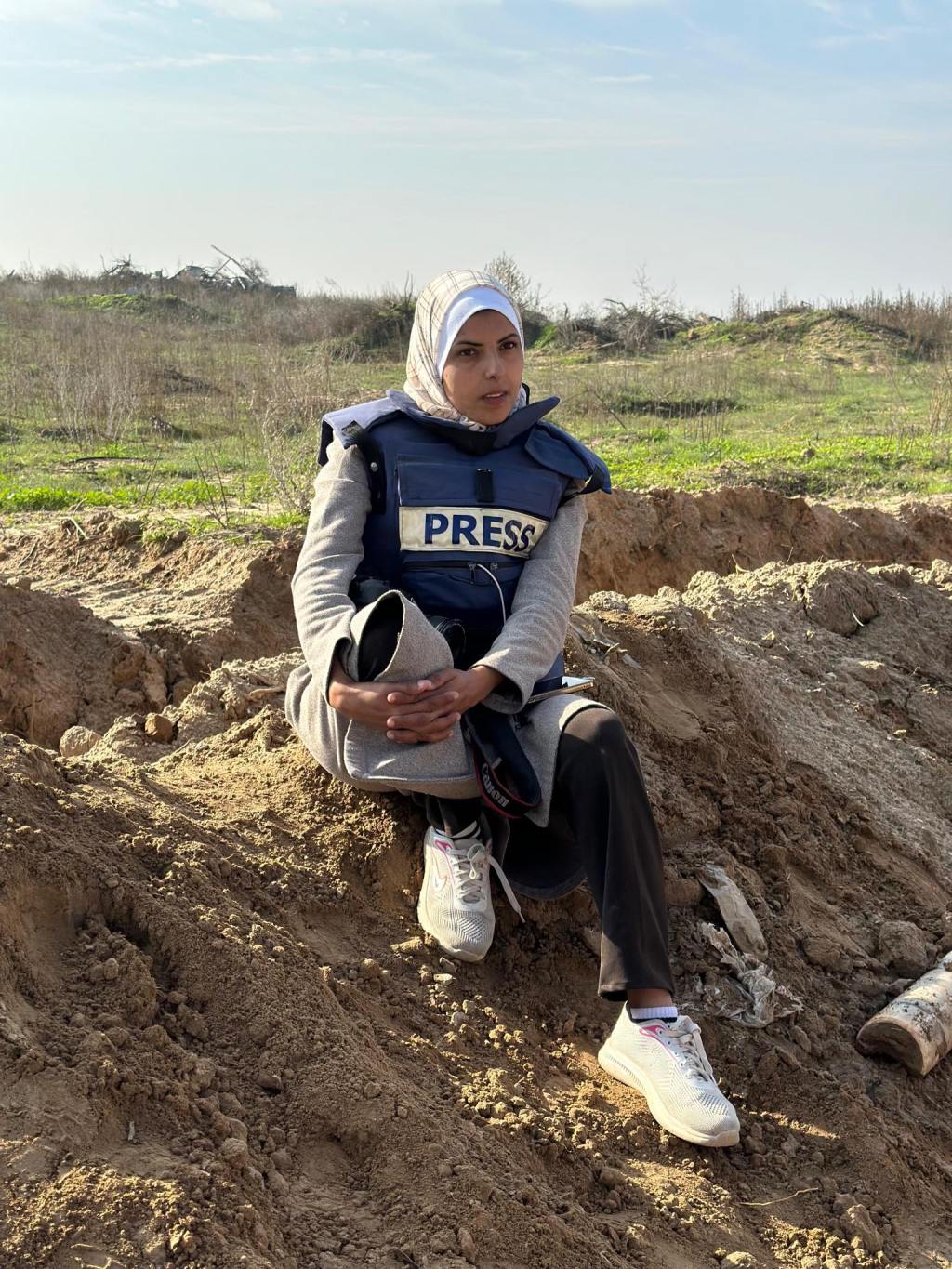
By Hedaya Shamun (*)
Nightmares hounded me so relentlessly that I did not sleep a full hour all night. My heart kept leaping, as if dozing on a sheet of searing metal. The city is very far from me physically, yet it crushes me with its closeness to my soul. I rise and take a few steps, staring into the thick darkness around me. The remnants of my home and those massacres whirl through my mind. Silence swallows me again, and I return, trying to outwit the night. I wake early, having swallowed a great quantity of tears, a lump in my throat tightening my breath. The beautiful, kind journalist Maryam Abu Daqqa was killed a few hours ago—indeed, a few days ago. She was carrying her camera, filming the wounded and injured on the stairway of the Nasser Medical Complex in Khan Younis. Many journalists and medics stood around her; some fell, killed or wounded, in front of cameras broadcasting live.
Maryam, I did not look for a photo of us together, nor did I search for words, messages, or hidden chats to proclaim to everyone—and I will not. All I remember are those moments when I saw you or heard you speak—quickly, spontaneously—while you smiled. With so much gentleness, manners, and simplicity, I knew no one with your natural ease. Whenever my friend Mona saw you rush over to speak to her, she would turn to me and say, “Oh God, how kind-hearted this young woman is.” The last time was during our final self-care training for women journalists at the museum—“the one all of Gaza knows, where not a stone stands upon a stone.” You were with us, right beside us, setting how we should sit, the blue backdrop behind us rippling with letters of the Arabic language. With your easy spontaneity, you would sometimes separate us a little and insist we needed beautiful photos—you would take them yourself. We still have your pictures, Maryam, glowing with beauty—just a fraction of the beauty of your spirit. Your eyes were beautiful, attuned to beauty; it pained you that your camera was being forced to record only tragedies, funerals, tears, collapse, and destruction.
How much you endured alone, Maryam—bold and brave, unfamiliar with fear. But look at your last photos: the war took so much from you—your tired features, your face grown darker, your fading eyes. Something was drawing you out of life, a vanishing glimmer, breaths heavy with worries, longing, and ache. It tormented you to see your city—its streets, homes, and people—stricken, hurting without support and without a hand to soothe their wounds. The people of Gaza now face killing at every moment, just as you faced so much—alone.
Photos and videos still live, bearing witness to a life of exhaustion and depletion, to the horrors of doomsday that Maryam lived and carried through her camera and short video clips. In one video, a sigh escapes her; a colleague urges her to speak, but she had no strength left. In certain brutal moments, it was as if she were saying goodbye, again and again. She mourned her mother with a shattered heart, and she parted from her son Ghaith, the dearest of hearts to her, to save him from what she endured in Gaza and so he might know a normal life. He left for another country, while she remained beneath extermination, striving to carry the voices of bereaved mothers, the crying of children who had lost everything, the shreds of bodies strewn around her, and the terrifying circle of dread for her family—her father, her sister, and the rest, who escaped death only to be forced into displacement. Maryam, the journalist and the human being, donated one of her kidneys to save her father from the pain of illness—so a living piece of her would remain beating within his body. No one knew this until after her killing.
She said it, and her voice still rings out: “I am the martyr who will escape from life, not from death.” Maryam wrote, in spontaneous words that captured the depth of Gaza’s pain and catastrophe today:
“I was there…
In the midst of the destruction, moving between groans and pleas.
The camera on my shoulder, my heart in my palm.
I felt exhaustion—yes. My body screamed for rest, and my eyes were about to close from sheer fatigue, but… I could not stop.”
Maryam bled from what she saw each day in a city wrung dry by war. Men, women, and families were killed in broad daylight. Children died of malnutrition. Each morning Maryam ran between hospitals and tents: here, a funeral for a child; there, a funeral for an entire family. She documented farewells, towering tears, and stifled screams. Through her lens she captured a bereaved mother’s cry, and a little girl calling for her father to rise from his white shroud, and a mother who said nothing—just stroked the hair of her son, drenched in his own blood. Maryam embraced everyone’s pain, standing firm despite a daily, silent dying. She bid a searing farewell to her colleague Ibrahim Hajjaj; his passing broke her. Her writings and her voice grew steeped in that heart-rending grief that hollows the chest—the kind that leaves the mourner dimmed, a different person who hardly recognizes herself and cannot quiet the sorrow. She wrote:
“By God, you were calm…
a support, a companion on the road and in life. The killing of my brother whom my mother did not bear—Abu Anas, the companion of work, the road, and life—by an Israeli strike in Gaza City… O God, protect him and illumine his grave as he was a light to my heart and the hearts of those who loved him; now he is in Your abode.”
For nearly seven hundred days she saw and lived it—every single day—running after funerals, after crushed tears, after hearts split open. She lived the grief of mothers and remembered her son Ghaith each time, wrapping herself in a little hope that she might one day see him as a young man in full bloom. But she did not see him—and will never see him again. She has passed to another realm, laying aside her press vest and helmet, even though she was killed in moments, on live air, with her fellow journalists, while documenting a strike at Nasser Hospital in Khan Younis, on the high stairways, before hundreds of patients and displaced people. An Israeli shell struck, killing her instantly. This is our beautiful Maryam—whom we all saw moments before her killing—there she stood, like an angel smiling, as if in a fated farewell. A smile was planted on her face even when she was weeping. This is Maryam. This is Gaza.
In August—the month Maryam departed, live on air—exhaustion had taken its toll on her. She wrote words steeped in pain, as if awaiting her turn to be killed. She had watched journalists assassinated one after another: some while doing their work; others at home with their families, in houses turned into inescapable graves. She wrote, with a grief that cuts to the bone: “When you see the earth covering what is most precious to you, then you will realize how trivial life is.” And in that same August, she wrote: “God will bring it about, even if it is delayed.”
Read her words—present yet absent—so like the people of Gaza in a raging genocide. She said: “Strangers in a world that does not resemble us, we wait for departure in silence.”
Day after day, Maryam wrote about wounded youths and children, striving to help them tell of their injuries and to save them from death while treatment failed to arrive. She filmed a video with a wounded young man and wrote: “Ahmed, a young man in his twenties, was injured by occupation missiles that left him unable to walk. He asks for the simplest of wishes: treatment abroad, so he can walk again and play the football he loves.”
On a photo she took of a small boy carrying an IV bag for his wounded father—older than his years, bearing mountains of worry and pain—she wrote: “In the emergency department at Nasser Hospital, a small boy no more than ten holds with his tiny hands a bag of blood larger than his body. He walks quickly and afraid, manhood etched on a face far older than his age.”
With aching longing for family she wrote:
“On the anniversary of my brother Mohammed’s killing, today we bleed a new bird—my nephew, Waseem Mujahid. Waseem… true to his name, he loved life and all who were in it. He loved people; in fact, he was of the people and for them. He helped everyone without being asked, took the initiative to give before being asked, steadied you with his gaze, and left his mark in your heart with his silence. Waseem, the calm… the gentle. He left us, and we remain with his memory. I do not know how I will visit his tent and not find him; how I will stand where he stood and not see him. Oh Waseem, oh the repeated loss, oh the pain that does not subside. The soul is burdened, dear one. With each face we love that disappears, the days grow heavier, and the lumps settle in our throats. In the presence of absence, we pray for memory to remain, for love not to be extinguished, and for your pure souls to abide in the light above.”
Maryam resembles Gaza—absent, yet still present.
In the heart of genocide, Maryam spoke for every woman journalist, every mother, every girl in Gaza:
“I miss my old self who was well. I miss my mind free of worries, thoughts, and anxiety. I miss my spirit, aged by hardships and responsibilities. I miss my strong, optimistic will, far from life’s harshness. I miss myself before she broke or grew sad. I miss my old laugh that truly came from the heart. I miss reassurance, safety, and rest. I miss the me who cared about nothing. I miss the old me who got lost from me—and it is hard to bring her back…!”
Her colleague, the journalist Ezzedine Abu Eisha, described her in his report for The Independent: she was not merely a journalist; she was a fighter carrying a camera, living the war as she moved among destroyed homes, crowded hospitals, and displacement camps, recording what the occupation does not want recorded.
Maryam was not the first targeted journalist, nor the second, nor the tenth, nor the twentieth. She left—and the killing of women and men journalists in Gaza did not stop. A few days after her, the journalist Islam Abed was killed with her husband and children, when an Israeli strike hit their apartment in Gaza City. The journalist Iman al-Zamli was killed when a quadcopter drone spotted her and opened fire while she stood in line to fill drinking water for herself and her family. One by one, women journalists fall before our eyes. We fear—terribly—for all the women journalists who remain in the Gaza Strip, from north to center to south. Journalists are targeted with brazen cruelty by the Israeli occupation. They face criminality not only in killing and targeting, but also in starvation and siege. Foreign and international press are barred from entering Gaza to cover crimes that have unfolded every minute and every hour for nearly seven hundred days, while the journalists—women and men—who remain inside Gaza are targeted, so that truth is killed, witnesses are killed, and the documentation of crimes against our fathers, mothers, and children is smothered. I write now as Rafah has been erased, and Gaza burns; residential blocks explode one after another by means of explosive robots sent in by the Israeli forces and then detonated. There is no journalism there now—no journalists able to cover crimes that happen every minute. They are killed elsewhere in Gaza, because they are the eyes of truth.
Maryam—her humility, simplicity, humanity, her running to carry the voice, her swallowing of sorrows and longing, and her hope to keep fulfilling a journalist’s duty—she is the face of the city still being annihilated. We mourn Maryam as we mourn Gaza. We weep, near and far, after she was erased by Israel’s killing machine—live, on air—just as Gaza is now being killed, its homes violated, its families buried alive. All we have left are ourselves, our remnants, and our voices drenched in deep red blood. Maryam, you have hurt us and left us wandering in our grief. Those women who remain in the media now wait for death, not life. Journalists carry their shrouds instead of their cameras. The world denounces and cries out from time to time, yet no one does anything to protect women and men journalists. What if we placed a black ribbon on our media platforms? What if we halted coverage outside Gaza? What if each day we published on a journalist, woman or man, still living/dying in Gaza? We want them alive among us; we do not want another obituary. We want them pulsing with hope—who will give the bereaved mothers hope that their voices reach the world? Do not wait for the extermination of those who remain in the media. Do more than that: stop relaying and exporting the official Israeli narrative—it is not a human voice; it is the voice of occupation. Tell your children and grandchildren that Gaza’s journalists, women and men, faced shells with their cameras, explosive missiles with their pens, tanks with their voices, and starvation, thirst, and daily humiliation with their images. Tell them that the word is humanity’s weapon, and that telling the story is what we possess to preserve what remains of our humanity. Save those who remain in Gaza.
Maryam wrote—on behalf of Gaza’s people and of journalists living in ruin under a merciless genocide:
“We pretend before everyone that we are fine. We stand firm, and go about our daily work as if it were normal. We speak a lot about patience—about loss, about everything. We are not fine.”
(*) A Palestinian writer and journalist from the Gaza Strip.



Leave a comment