
Written by: Hedaya Shamun (*)
Today, I will write about the forced starvation of our young men and women, our children, girls, and the elderly. However, I will not borrow words from my heart burning for Gaza, nor will I emulate my colleagues in Gaza in their painful sense of the meaning and taste of hunger. Yes, hunger has a bitter taste and a foul odor. No matter how much others write about it, they will never be able to capture its features, because it gnaws at the soul. While it collapses, a terrible emaciation must overcome it to write and to survive for the sake of its children. It is the feeling that all the young men and women of Gaza, all its children and women, live with, chewing at the taste of hunger. There is no taste but deprivation, and no words but exhausting gestures and endless screams while the world turns a deaf ear to them…
“Save what remains and whoever remains of us…!”
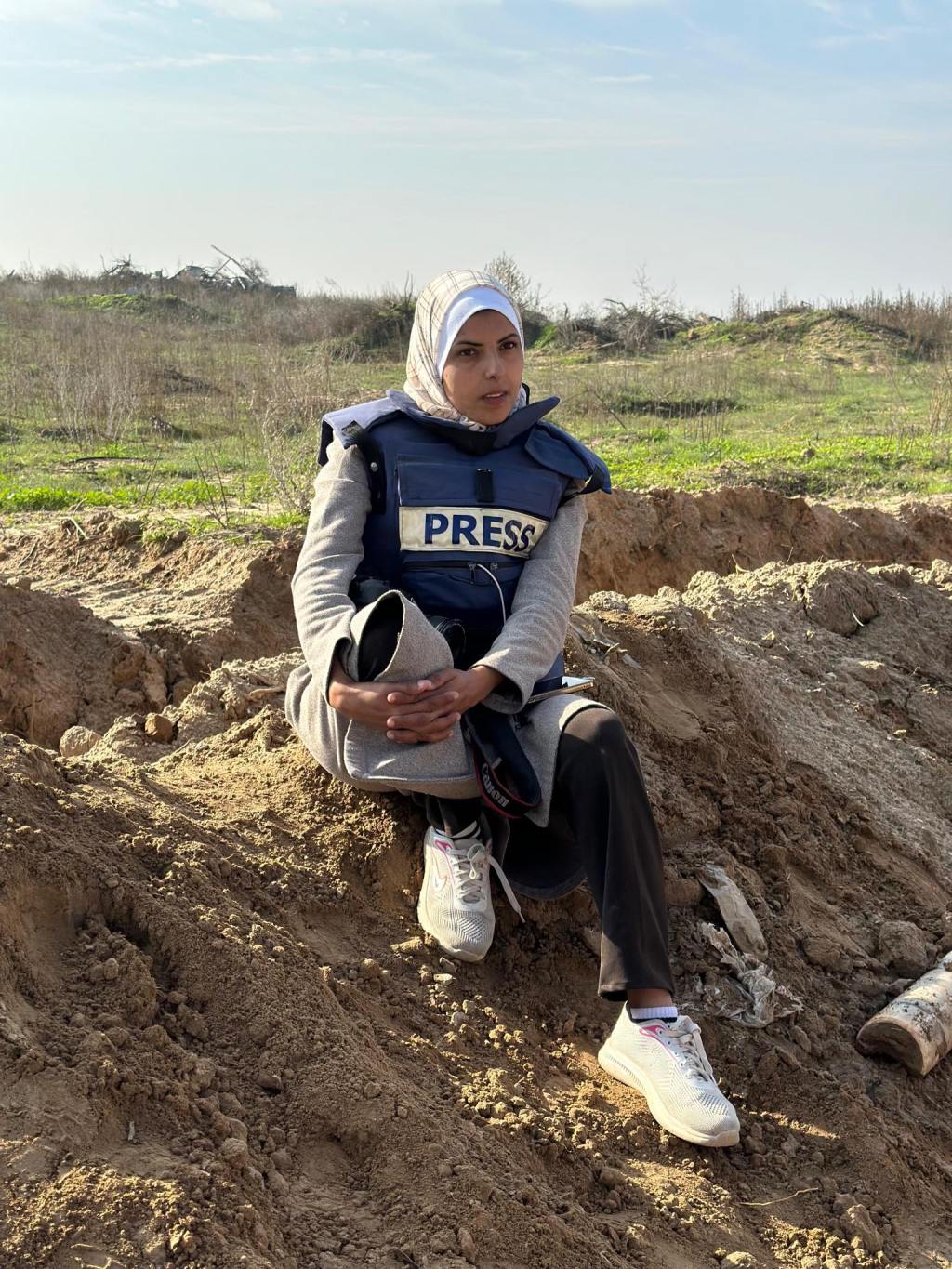
Today’s blog will carry for you the words of some of my fellow journalists, male and female, as they write about hunger and pain, and even barter for a handful of flour on their cameras, their only source of livelihood in the shadow of a merciless genocide. Do not apologize or feel pain for them; feel pain for your humanity. Those who bang pots on the roof of their houses are less important to us than those who turn their faces away from us. Our fallen skeletons in the streets, and those who recite the names of thousands of our child martyrs, working day and night to honor their souls, are less important to us than those who recite verses of patience and reward, as if it is destined for our people to live the torments of genocide, killing, displacement, emigration, the collapse of the family, the loss of loved ones, the loss of livelihood, peace and security, and crying out of pain, injustice and grief for nearly two years. Those who are tired are those who watch the massacres…! And those who are disgusted are those who saw our spilled blood and returned asleep, satiated and safe, weeping for us secretly and fearfully, apologizing as if the hungry can hear apologies…! The universe did not rise for our children, nor did it destroy idols to starve and besiege us. It is as if we were destined to live a life scorched by the scorching heat of horrific death. The young men and women of Gaza have no future today, in light of the famine caused by the Israeli occupation, the ongoing siege of the Gaza Strip, the closure of crossings, the prevention of humanitarian aid from entering Gaza, and the bombing and killing of all those working to provide humanitarian aid. This blog today is a window to their voices, their words, and their grief for us. Let the whole world hear that dear, honorable Gaza is starving after the killing, destruction, and devastation. Our voices and their voices belong to history, and were never meant for this miserable present…! A spirit that resists amidst the rubble of days…! Journalist Ahmed Ghanem writes on his Facebook page: “Over two years of war, I lost between fifteen and twenty kilograms, but in the last week alone, I lost five kilograms at once. But the truth is, what is being lost is not just weight, but something much deeper. We are not only losing fat and muscle, but also our energy, our strength, our vitality, the light in our faces, and the glow in our eyes. We are losing our ability to get out of bed as we used to, to smile spontaneously, to laugh heartily. We are losing our emotional response, as if our bodies are slow to grasp meanings, as if our minds are gradually turning off the lights of focus. Everything is slowing down: our heartbeats, our movement, and even our dreams. War is no longer just bombing, falling, and destruction. It has become a silent, internal erosion that penetrates the body and soul. We are withering like a plant left without water or sun. We are weakening every day without noise, and we are fading without a farewell. We are losing ourselves silently, as time crumbles ancient statues, one grain of sand after another. This is not just hunger, but a state of general extinction, where your life is consumed while you are alive.” When you look in the mirror, you don’t just see a thin face, but a body that resists and a soul that walks barefoot in the rubble of days. This loss is not measured in kilograms, but rather in how much of what is no longer in us is what it was.” As for journalist Duaa Rooqa, she says and writes: “I say it frankly after covering and continuing for 656 days of genocide and work: I am exhausted. We have reached a very difficult stage in the bitter reality we are living in the Gaza Strip and the intensification of famine. We are working in very difficult conditions and with great restrictions at the expense of our frail bodies and our exhausted health. We are tired. Oh God, be with us. Oh God, stop the genocide in Gaza. We are dying of hunger.”
Journalist Saleh Al-Nattour, a correspondent for Al-Arabiya TV, who, while standing firm, can see how exhausted he is by war, siege, and starvation, yet continues to deliver his media message despite his fatigue and exhaustion, writes: “We have been in this devastating war for 600 days, and it’s not over yet. This is my testimony for the rights and freedom of the press in the world: Everyone here is trying to stay alive, but dozens of us have not been able to make it. In this part of hell, escaping death does not mean that we have completely escaped its devastating effects. Over time, we have gradually begun to lose some of our human nature. We are no longer affected as we were before by scenes of death, burning or torn bodies, and we are no longer disgusted by the smell of blood. We have been told that it is a pathological condition known as “burnout,” and we may need treatment that lasts for months or years. Who knows? Until then, each of us is overcome by a desire for isolation, withdrawal, and silence more than speaking. We catch ourselves when we smile or laugh in a good way.” Aber… I don’t know of any other place where journalists have worked to cover such a deadly war, for 600 consecutive days, without adequate safety measures and in a dangerous and harsh working environment
Without a home, without food, without time to sleep, and even without adequate clothing, their offices were destroyed. They worked in the streets, in tents, and slept in public squares, under hospital stairwells, and on hospital walls. They were also displaced with their children from one city to another, trying to protect them
Teared armor remained, and camera equipment broke down dozens of times. They rode “karts”, livestock and goods carts, and walked dozens of kilometers to work, until their shoes were torn. They starved, drank contaminated water, ate spoiled food, and fell ill numerous times. They lost dozens of kilograms, sustained serious injuries, and lost limbs. Working here is almost impossible, yet they continued their profession for 600 days
With all the pain and anguish, the journalist writes Yaffa Abu Aker described the pain of starvation she feels as a human being living through genocide in all its details:
“We didn’t close our eyes for a single minute. Everything was falling on our heads: war missiles, artillery shells, terrifying sounds that tore apart the silence and burned what remained of our nerves… They targeted an exhausted, weak body, barely able to stand… We are alone in this blind world… Who else do we have but us?”
She wrote in colloquial Arabic in another post:
“Literally, without shame, we can’t find anything to eat in Gaza City! Famine has reached its highest levels in Gaza… People are walking in the streets, talking to themselves while they are hungry, oppressed, and their eyes are absent. People have stopped understanding anything… Exhaustion, exhaustion, and children crying from hunger and thirst, and the arduous journey of displacement. There is no baby formula, no supplements, and nothing we can support ourselves or our children on. Gaza is dying, and the world is watching. Be our voice.” Convey our pain and our grief. May God not forgive those who let Gaza down. Fainting on and off the air due to hunger…! Journalist Sally Thabet, who never stopped covering the war, fainted while presenting her report with Al-Kofiya TV. A few days later, she wrote to thank everyone who supported her and indicated that she was one of the starving Gazans. She wrote: “Thank you to everyone who asked and checked in… and to all the colleagues, both male and female. I fell while performing my message and my sacred mission, live on air… My strength collapsed, my heart began to beat rapidly, I felt my blood pressure drop, and I began to sweat… In addition to nausea and dizziness… I told myself to persevere and be patient, for all the fatigue and exhaustion forced me to fall… I asked permission from my colleague Jumaa Abu Shomar, the newscaster in Cairo on Al-Kofiya TV… and I told him, ‘Excuse me, Jumaa, I cannot stand and continue talking about the massacre of the starving, and I am, by God, one of them.’ I grabbed my colleague Hudaa Al-Dahdouh and found myself inside the reception desk… This is our situation and our fate in Gaza: we cover the events, and suddenly we are the event… Please pray for our survival.” And perseverance to complete the journey.
Photojournalist Magdy Fathy wrote with the pain and grief of a father: “Amid this deadly famine, I will tell you about my son Yazan, who suffers from autism. Since I discovered his autism, I have been helping him learn and fill his day between attending an institution where he can learn and qualify, and having fun at the beach and the Yarmouk Stadium, riding a bicycle, and learning to swim in a private pool. He never asked about food because he spent so much time outside the house. This was part of his treatment and to release negative energy. Since the beginning of the war, all of this has disappeared. He no longer goes out, there are no places to go. His condition and behavior have changed. The war has destroyed everything I built with him and for him over many years. Yesterday, for the first time, he came to me, banging his stomach hard. He won’t speak. He’s hungry, and there’s nothing I can buy from the market for him and his siblings. He doesn’t know we’re in a war or famine. He just wants to eat.”
The camera is opposite a bag of flour for his children…!
There is no eloquence in language, nor is there a description of the current state of journalists, youth, and residents of the Gaza Strip. What journalist Bashir Abu Al-Shaer wrote and said is a cry in the face of all those who have closed off Gaza and witnessed its killing, siege, and now starvation without taking action:
“I am citizen Bashir Fathi Kamel Abu Al-Shaer, a freelance Palestinian journalist from Gaza. I am 42 years old, married, and have seven children, including my daughter Rama, who suffers from a chronic illness. I work as a freelance journalist on a piecework basis with various channels and media organizations.
I am the author of the post that received a great deal of interaction from social media users about my decision to exchange my camera for a sack of flour to satisfy my children’s hunger. I write to you these words about the main motive for offering my camera for exchange…
There was once a popular proverb that said… “No one dies of hunger,” but these words fell on the borders of the Gaza Strip and have become a byword. Everything alive in Gaza has died of hunger, and those who remain alive are fighting for survival.
Famine is growing in besieged Gaza day after day. One day, lives are being harvested, exhausted by pain and hunger, as it does not exclude anyone (siege, starvation, displacement, killing, exile). All of these are tools used by the Israeli occupation against civilians inside the Gaza Strip. Our bodies have become worn out, and we are no longer able to move. We, our children, and everyone else have not eaten bread for days, and the markets are empty of all types of food. We see our children starving and screaming from the severity of deprivation, and we cry because we are unable to satisfy their hunger. We no longer have the energy to bear this pain. We see our children dying before our eyes, and the world does not move a finger. We go out every day, walking with swaying steps from the severity of hunger, to document the suffering of citizens from the oppression of famine. These citizens do not know that we have also left our children hungry like them. For more than a year and eight months, we have been documenting the events and painful scenes due to the Israeli war on the Gaza Strip. We are afflicted with fear, hunger, displacement, and the loss of those we love, but every time we continue to cover despite these hardships. Yes, I am a journalist carrying my camera, trying as much as I can to deliver the message of my starving people. But I am part of the social fabric. I go hungry as they go hungry, and what afflicts them afflicts me. Therefore, I no longer have the energy to bear what we are going through. Sometimes I ask myself, what is the use of a camera and a photograph when they cannot satisfy my children’s hunger, and when I am absent and their bearer goes hungry? Therefore, I decided, with all my mental faculties, to replace my camera with a sack of flour to save my children and family from death and the famine that is gnawing at our souls. I published my message on my Facebook account. However, the bitter truth that no one knows is that when I decided to replace my camera with a sack of flour, my heart ached because it is difficult for me to part with it. It is my companion in all aspects of reporting and documentation, and my third eye through which I see the world and convey the message of my starving people. Yes, it was a difficult decision for me, but if the price is saving my children from death, then I am satisfied with my decision, and I pledge to remain committed to fulfilling my journalistic mission, even if I have to use a pen instead of my camera. My message to the world: I am a Palestinian journalist who has been wounded twice and escaped death many times, and our home was mercilessly bombed. I am not the only one who is starving in Gaza. Also, my fellow journalists are starving, and about 2 million citizens in Gaza are starving, so save us before it’s too late.”
Before it’s too late…
What I have conveyed here is just a drop in the ocean of pain, starvation, and oppression spoken by those who have been forced to flee their homes for nearly two years. They have sought shelter under the sky, which only plots murder and death. They have taken refuge in a tent that offers neither protection from the summer heat nor the winter cold. They have been eating lentils and legumes for months, and have drunk contaminated water. Now they are falling one after the other while flour ambushes await more of them to kill. They have shown no mercy to the old or the young, and starvation has affected all segments of society. Before it’s too late, heed their words. Before it’s too late, save their children. Before it’s too late, save what remains of your humanity…!
________________________________________
(*) Palestinian writer and journalist from the Gaza Strip



Leave a comment